Main Objective
Let AI handle the volume so recruiters can focus on decisions.


A custom AI recruitment platform for a growing agency. Connected APIs pull in CVs from multiple platforms, and AI reads, matches, ranks and summarises every candidate and drafts job adverts. Recruiters step in only to approve shortlists and make the final decisions.
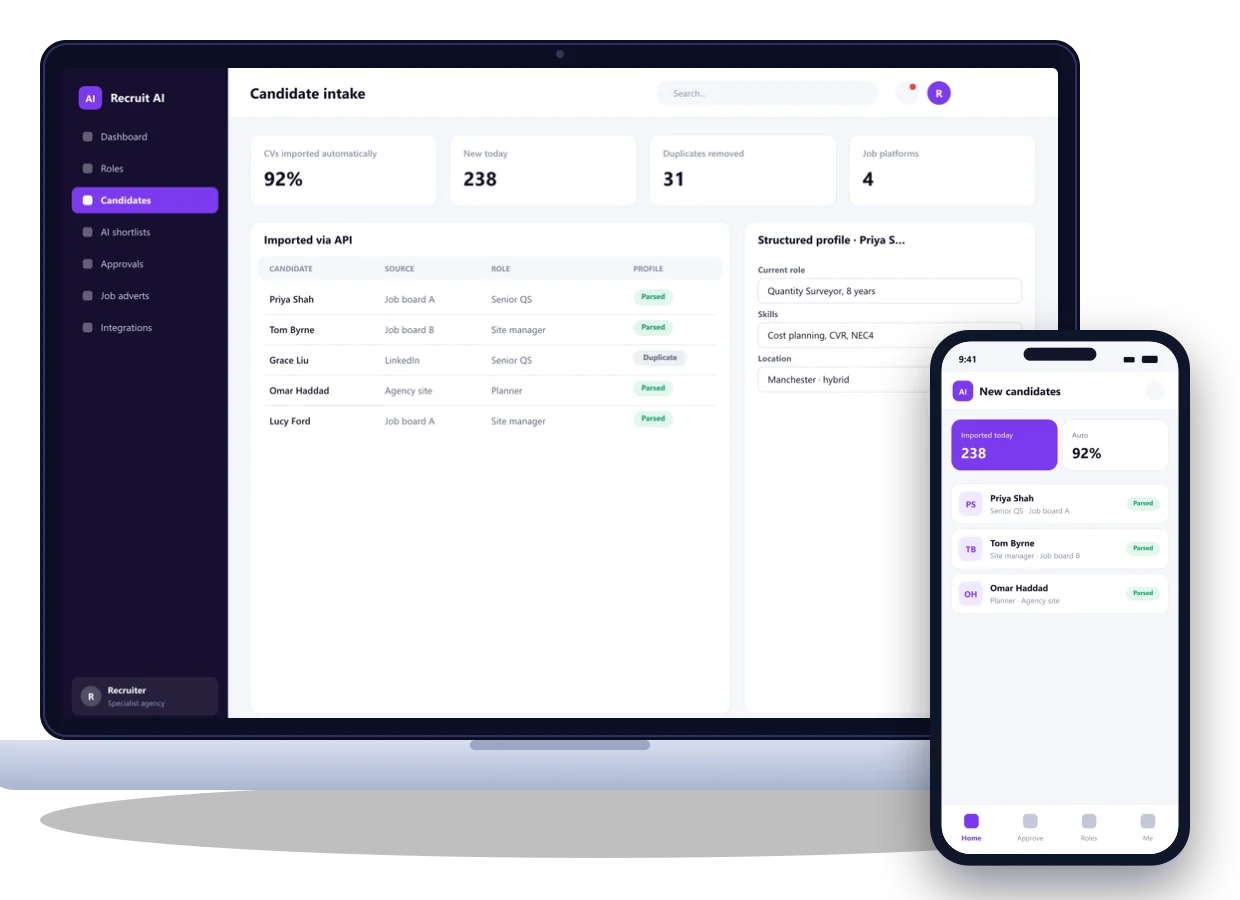
Our client is a growing recruitment agency placing candidates with businesses across several sectors. Their recruiters manage dozens of open roles at once, with applications arriving from several job platforms every day.
They were paying monthly for an off-the-shelf tracking tool and still doing most of the work by hand. Recruiters downloaded CVs from different platforms, copied details into spreadsheets and read every application. The agency wanted a platform where AI did the heavy lifting and recruiters only stepped in to make decisions.
Let AI handle the volume so recruiters can focus on decisions.
Less manual screening, faster shortlists and automatic CV intake.
The agency's recruiters were good at their jobs, but four connected problems buried them in admin. Each one made the others worse.
CVs arrived from several job platforms and inboxes, and recruiters downloaded and re-entered each one by hand.
Hours were lost to copying and pasting.
Every CV was read and scored by a person, so busy roles took days to shortlist.
Shortlists reached clients too slowly.
The off-the-shelf tool forced its own stages and fields on the team, so recruiters worked around it rather than with it.
The tool didn't fit the agency's process.
Managers couldn't easily see pipeline health, time-to-shortlist or recruiter workload without building reports by hand.
Decisions relied on guesswork.
What the client wanted to achieve: a platform where AI handles sourcing, screening and writing, and recruiters only step in to approve shortlists and make hiring decisions.
Before writing any code, we mapped how the agency works and which tasks AI could take over safely.
We shadowed recruiters to see which tasks were repetitive enough for AI and which needed human judgement.
We reviewed applicant tracking systems and the APIs of the job platforms the agency used, checking what data each one could provide.
We mapped three user types: recruiters approving shortlists, team leads managing workload and admins handling access and integrations.
AI is fast at reading and ranking, but people are better at judgement. So we automated the volume and kept a person at every decision point.

A structured eight-week approach kept every stage transparent and on time. Select a stage to see what happened.
We ran workshops with recruiters and managers and mapped every step from a new role arriving to a placement. We marked which tasks AI could take on.
Drag the handle to compare the old tools with the new platform.


Both views are illustrations: the “before” shows the old way of working, the “after” shows the new system. Client data is not shown.
Four connected workstreams, each one solving a specific part of the challenge.
Connected APIs pull applications from the agency's job platforms straight into the right role. AI turns each CV into a structured profile and removes duplicates, so no one copies details by hand.
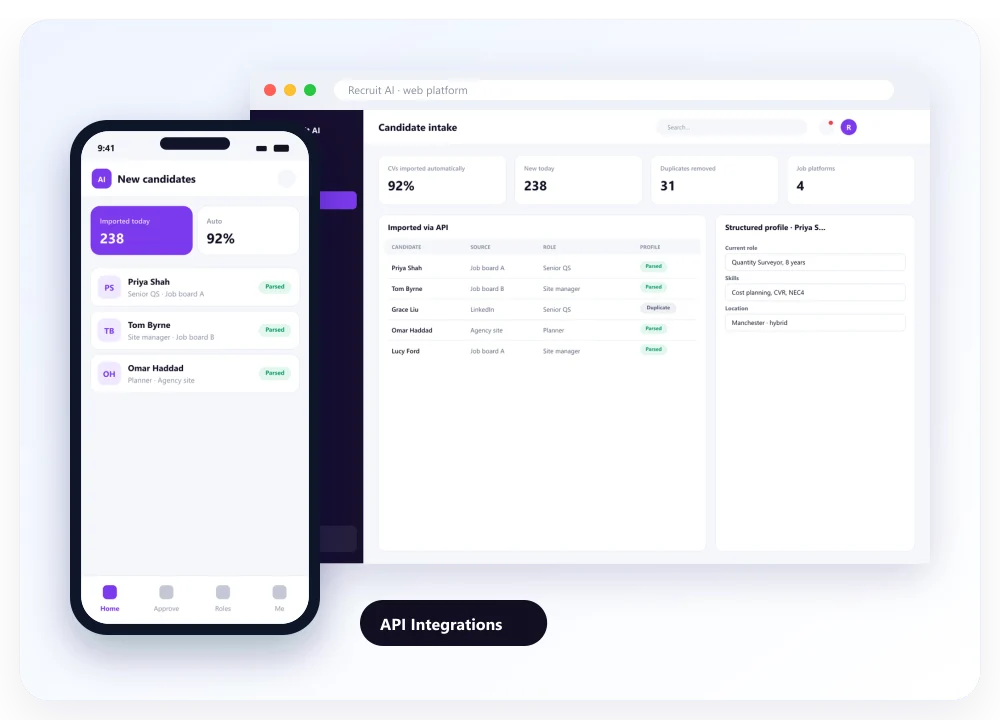
AI scores each candidate against the role's requirements, ranks the pool and writes a short summary explaining each match. It also drafts job adverts from a brief, ready for approval.

Recruiters approve shortlists, job adverts and candidate progress at clear decision points built around the agency's own stages. They can overrule the AI at any time, and everything else runs automatically.

A live dashboard shows open roles, pipeline health, time-to-shortlist and recruiter workload. Managers can spot bottlenecks and move people where they're needed.
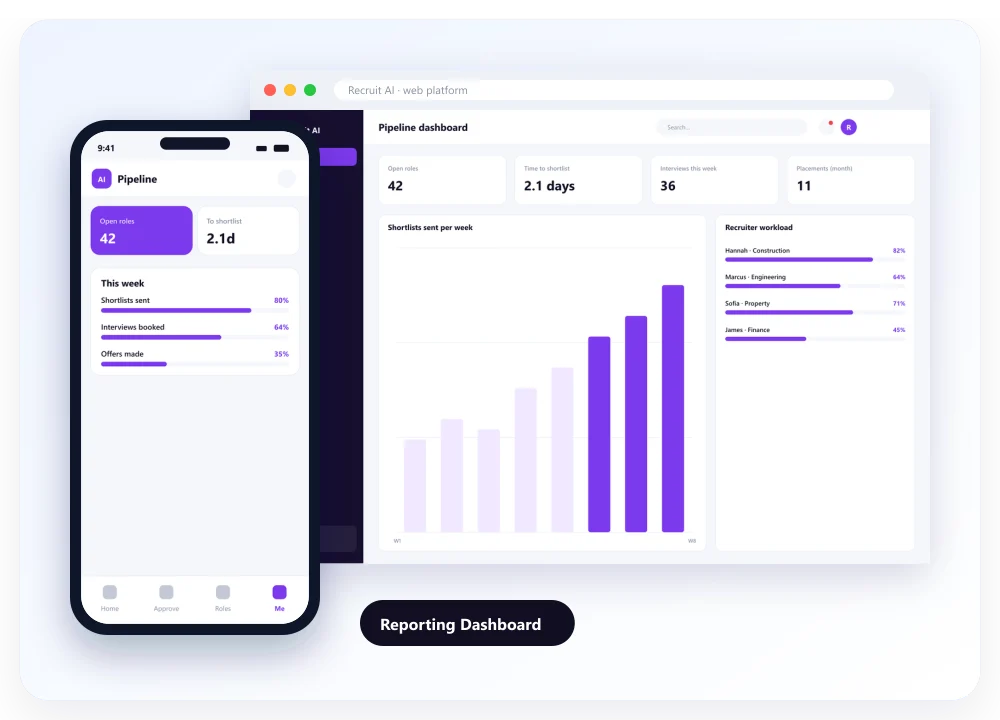
The finished platform on desktop and mobile, with automatic CV intake, AI rankings and the approvals queue.
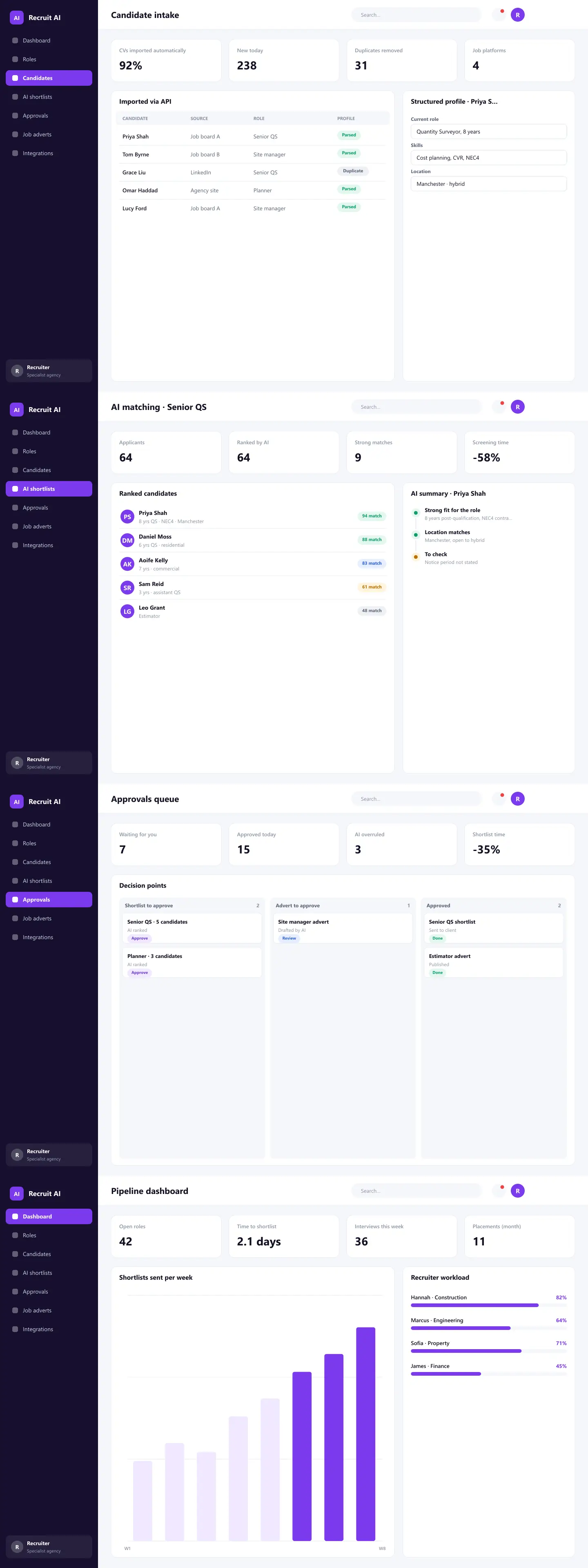
Hover over a screen and scroll through the product screens.
Measured improvements in the first 90 days after launch.
AI ranking and summaries replaced first-pass CV reading.
Average time from a new role to a client shortlist.
Applications arriving through connected platforms, not manual uploads.
Letting AI handle the volume changed how recruiters spend their day. CVs arrive and are ranked automatically, shortlists reach clients sooner, and recruiters spend their time on the decisions that need a person.
“Our recruiters used to spend most of the day downloading and reading CVs. Now the platform pulls them in, ranks them and explains why, and we just make the calls. CodeCrackers built exactly the way we wanted to work.”

CodeCrackers designed, built and launched Vantro, job-management software for small UK trade businesses. It covers scheduling, quotes, invoices, a mobile app for engineers and subscription billing. Vantro went from idea to paying customers in eight weeks.

CodeCrackers built a custom iOS and Android app for a UK driving school with 18 instructors. Pupils now book, pay and track their progress in one place, and instructors manage their diaries on the go. No-shows fell by 42%.
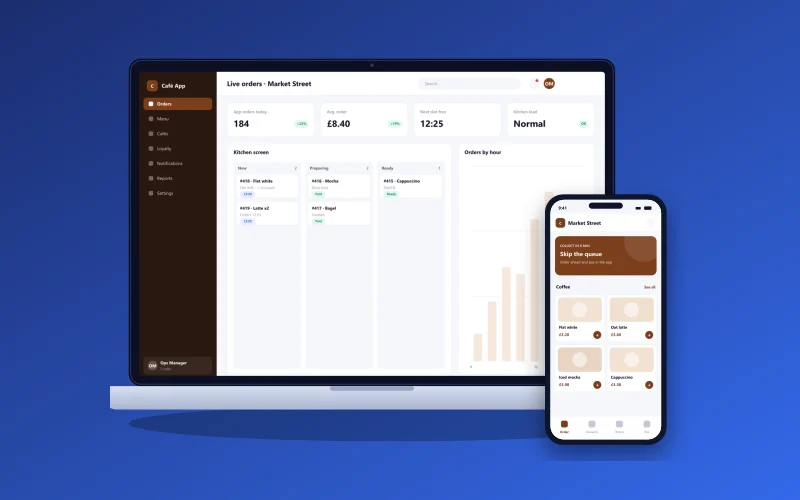
CodeCrackers designed and built a custom iOS and Android app for a group of five UK cafés. Order-ahead, digital loyalty and push offers, all connected to their existing tills, turned lunchtime queues into quick collections and casual customers into regulars.


